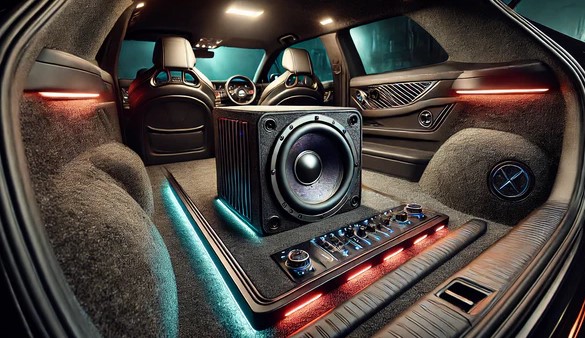
You’re cruising down the highway at 60 mph, the windows are down, and your favorite track finally hits that legendary drop. You brace yourself for the chest-thumping “oomph”—but instead of a deep, resonant rumble, your speakers emit a pathetic, paper-thin thwack. It’s a heartbreaking moment for any music lover.
In my fifteen years of tearing apart door panels and soldering crossovers, I’ve realized that most people think “deep bass” requires a trunk-consuming subwoofer box. While a sub is the king of the low-end, you’d be surprised at how much ground you can gain just by choosing the right door speakers.
Today, we’re doing a deep dive into the best car speakers for deep bass. I’ll help you navigate the sea of technical specs so you can transform your car from a tinny tin can into a rolling concert hall.
The Physics of “Feel”: Why Most Speakers Fail at Bass
To get deep bass, you have to move air. A lot of it.
I like to use the Swimming Pool Analogy: Imagine trying to create a massive wave in a pool. If you use a tiny dinner plate (a standard factory speaker), you have to move it incredibly fast to get even a small ripple. But if you use a large, sturdy plywood board (a high-quality aftermarket woofer), a single, slow push creates a wave that moves the whole pool.
-
The Problem: Factory speakers are usually made of cheap paper. When you turn up the bass, the paper flexes and distorts because it isn’t rigid enough to “push” the air effectively.
-
The Solution: High-end speakers use materials like Polypropylene, Kevlar, or Carbon Fiber. These materials stay stiff under pressure, allowing for that punchy, accurate low-end.
The Contenders: Best Car Speakers for Deep Bass in 2026
Based on my hands-on testing and the latest technical benchmarks, here are the top picks for those who want to feel the music without sacrificing clarity.
1. Kicker 51KSC6504 (KS Series): The Heavy Hitter
If you want bass on a budget, Kicker is usually the first name I mention. Their KS Series is designed specifically for high-performance low-end in a coaxial format.
-
Frequency Response: 43Hz – 21kHz.
-
Why it wins: They use a heavy-duty motor structure and a polypropylene cone that can handle significant “excursion” (the distance the cone moves).
-
Best For: Mid-range builds where you want a direct factory replacement that packs a punch.
2. Focal EC 165 KE (K2 Power Series): The Audiophile’s Choice
Focal is like the Ferrari of car audio. The K2 Power series uses a distinct yellow Kevlar/Glass Fiber sandwich cone.
-
Key Spec: 93dB Sensitivity (this means they are incredibly efficient at turning power into sound).
-
The Insight: These speakers provide “tight” bass. It’s not just loud; it’s accurate. You’ll hear the difference between a synthetic 808 and a real bass guitar string.
3. JBL GTO629: The “Hidden” Powerhouse
JBL uses a patented Plus One™ cone technology, which creates a larger surface area than other speakers of the same size.
-
Technical Advantage: Larger surface area = more air moved = more bass.
-
Pro Tip: These are 3-ohm speakers. They are designed to pull a bit more power out of your factory head unit, making them sound much “fuller” than standard 4-ohm replacements.
Technical Terms You Need to Know (LSI Context)
When you’re shopping, don’t just look at the picture. Look at these three metrics:
-
RMS Power Handling: Ignore “Peak Power.” RMS is the continuous power the speaker can handle. For deep bass, look for at least 60W – 100W RMS.
-
Frequency Response: Deep bass lives in the 20Hz to 80Hz range. Most door speakers struggle below 50Hz, so look for a “low end” number as close to 40Hz as possible.
-
Sensitivity: Measured in decibels (dB). A higher number (over 90dB) means the speaker will play louder and bassier even if you don’t have an external amplifier.
Component vs. Coaxial: Which is Better for Bass?
I often see beginners buy Coaxial speakers (the ones with the tweeter built into the middle) because they are easier to install. However, if you want the best possible audio stage, you want Component speakers.
-
Component Systems separate the woofer from the tweeter. This allows the woofer to be mounted low in the door (where it can use the door cavity as a “box” for more bass) and the tweeter to be mounted higher for clear vocals.
-
The Crossover: Component systems include an external “brain” (the crossover) that ensures only the low frequencies go to the woofer, preventing it from “muddying” the sound.
Expert Advice: The “Invisible” Bass Upgrade
Here is a secret that many shops won’t tell you: The best speakers in the world will sound like trash in an untreated door.
When a speaker moves forward to create a bass note, it also creates a “back wave” inside the door. If that wave bounces off the thin metal of your door, it cancels out the bass you’re trying to hear.
Tips Pro: Invest $50 in Sound Deadening Mats (like Dynamat or Hushmat). Applying these to the metal inside your door stops the vibration and turns your door into a sealed acoustic chamber. I’ve seen $100 speakers with sound deadening outperform $400 speakers without it. Every. Single. Time.
The Bass Myth
Don’t fall into the trap of thinking a 6.5-inch door speaker will rattle your rearview mirror like a 12-inch subwoofer. It won’t.
Physics is a stubborn teacher. A small speaker can give you “Mid-Bass” (the kick of a drum), but “Sub-Bass” (the low-frequency hum that makes your hair stand up) requires a dedicated subwoofer. Use high-quality door speakers to bridge the gap, but don’t expect them to do a sub’s job.
Conclusion: Ready to Crank It Up?
Upgrading to the best car speakers for deep bass is the fastest way to fall in love with your commute again. Whether you go for the raw power of Kicker, the precision of Focal, or the efficiency of JBL, remember that the installation—and specifically sound deadening—is 50% of the battle.
Are you planning a full system overhaul, or are you just looking to swap out your buzzy factory speakers? Let me know in the comments, and I’ll help you figure out which material and size will fit your specific ride!